
Tools & Resources · Reference
Unauthenticated RCE, by stack layer
In the past twelve months an unauthenticated remote code execution bug landed on every layer of a web stack below your own code. The framework. The libraries it imports. The language runtime beneath them. The reverse proxy in front of the lot, which for nginx fronts roughly a third of the web.
PHP2Shell, MongoBleed, KindaRails2Shell, React2Shell, nginx2root. Different products, different kinds of flaw, and none of them needed a login. Each reads attacker-supplied input before anyone has authenticated, in a feature that is usually switched on by default.
Full analysis: Unauthenticated RCE: Where Pre-Auth Bugs Really Live
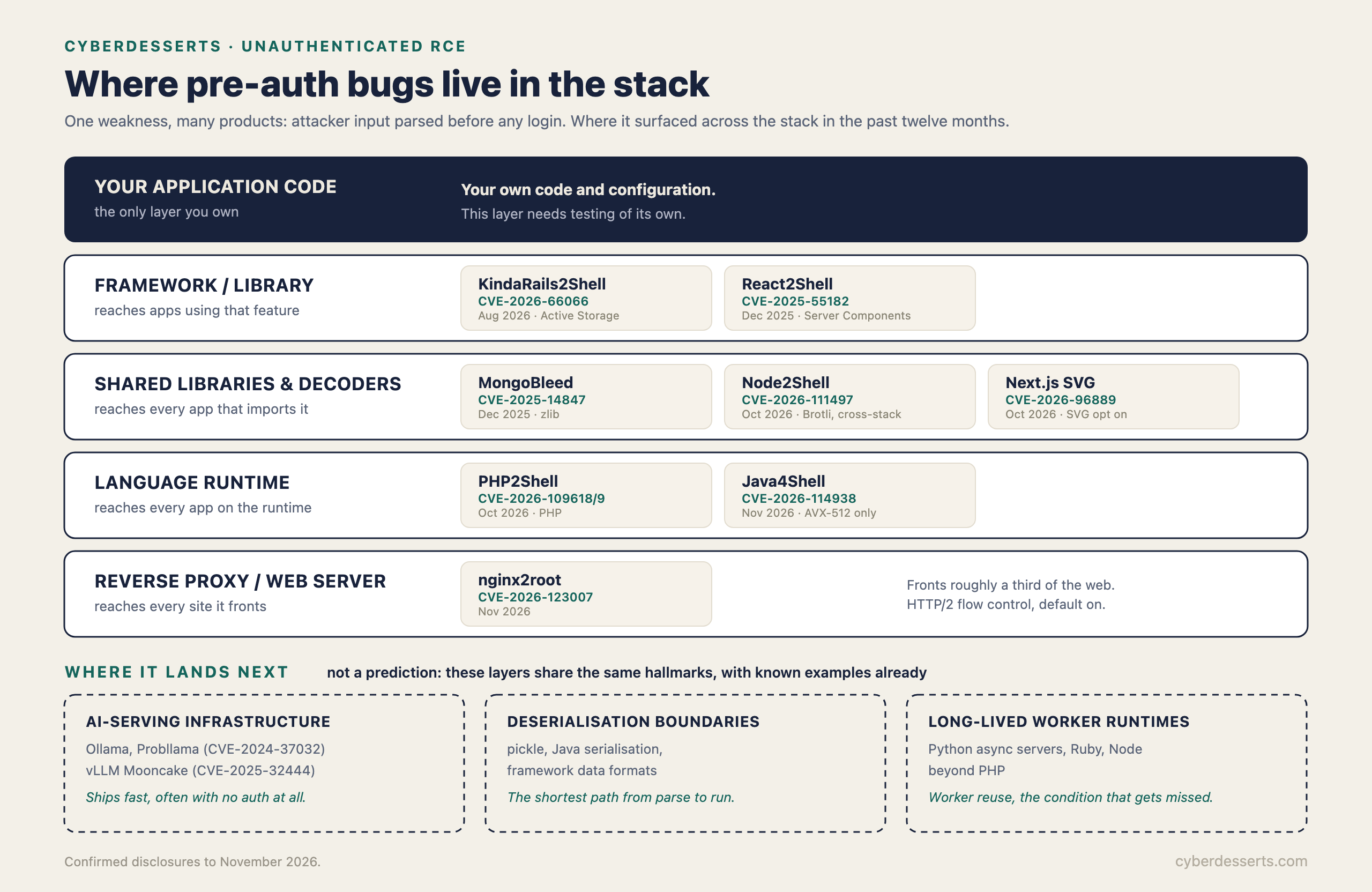
The Incidents in Detail
| Incident | Layer | Pre-auth input | Who's exposed | The fix |
|---|---|---|---|---|
| KindaRails2Shell | Framework (Rails Active Storage) | an uploaded image, default processor | every Rails app using the default image variant | disable the unsafe libvips loaders by default |
| React2Shell | Library (React Server Components) | the serialised payload a browser posts back | every app using React Server Components | fix the deserialisation in Server Components |
| MongoBleed | Decoder (zlib, in MongoDB) | zlib-compressed wire-protocol headers | every reachable MongoDB with zlib enabled | validate the length fields in zlib decompression |
| Node2Shell | Decoder (Brotli) | Brotli-compressed bytes, decoded before auth | any service decompressing untrusted Brotli (Node, .NET, Python) | bound the output of the Brotli decoder |
| Next.js SVG | Decoder (librsvg, in Next.js) | a crafted SVG to the image-optimisation path | Next.js on glibc Linux, SVG optimisation on | patch the librsvg use-after-free behind sharp |
| PHP2Shell | Runtime (PHP engine) | request data on memory-limit and cleanup paths | every app on an unpatched PHP version | reset request state at request end; cap upload memory |
| Java4Shell | Runtime (JVM / OpenJDK) | a Base64-encoded token, decoded before the auth check | JVM apps on x86-64 with AVX-512 (OpenJDK 17.0.6+) | bound the output length in the Base64 decoder intrinsic |
| nginx2root | Reverse proxy (nginx) | HTTP/2 flow-control frames on a default listener | every nginx with HTTP/2 enabled (1.9.5 to 1.31.8) | correct the send-window accounting so the counter cannot underflow |
Source: CyberDesserts analysis; CVE details from the linked advisories.
Why Depth Matters
The layer decides the blast radius. A bug in your own code reaches your users. A bug in a framework reaches every app using that feature. A bug in a decoder reaches every app that imports it, often across languages. A bug in the proxy reaches every site it fronts, which for nginx is roughly a third of the web. Nothing about the flaw changes as you move down the stack, only the number of people holding it.
What To Do With This
- Inventory the layers, not just your code. Most of this list is software you did not write and may not have chosen deliberately.
- Find what parses before auth. Decompression, image processing, deserialisation and token decoding all run before a login check in more places than teams expect.
- Turn off defaults you do not use. Every incident here rode in on a feature that was enabled without anyone asking for it.
- Restart workers on error. Long-lived processes that keep state between requests are the condition that turns a parsing bug into code execution.
Why they are the same bug, the conditions they share, and the structural fixes: read the full analysis.
Browse every article in the Library →
Explore all free tools and downloads in Tools & Resources →