
Tools & Resources · Free Download
Build a Cybersecurity Portfolio That Gets You Hired
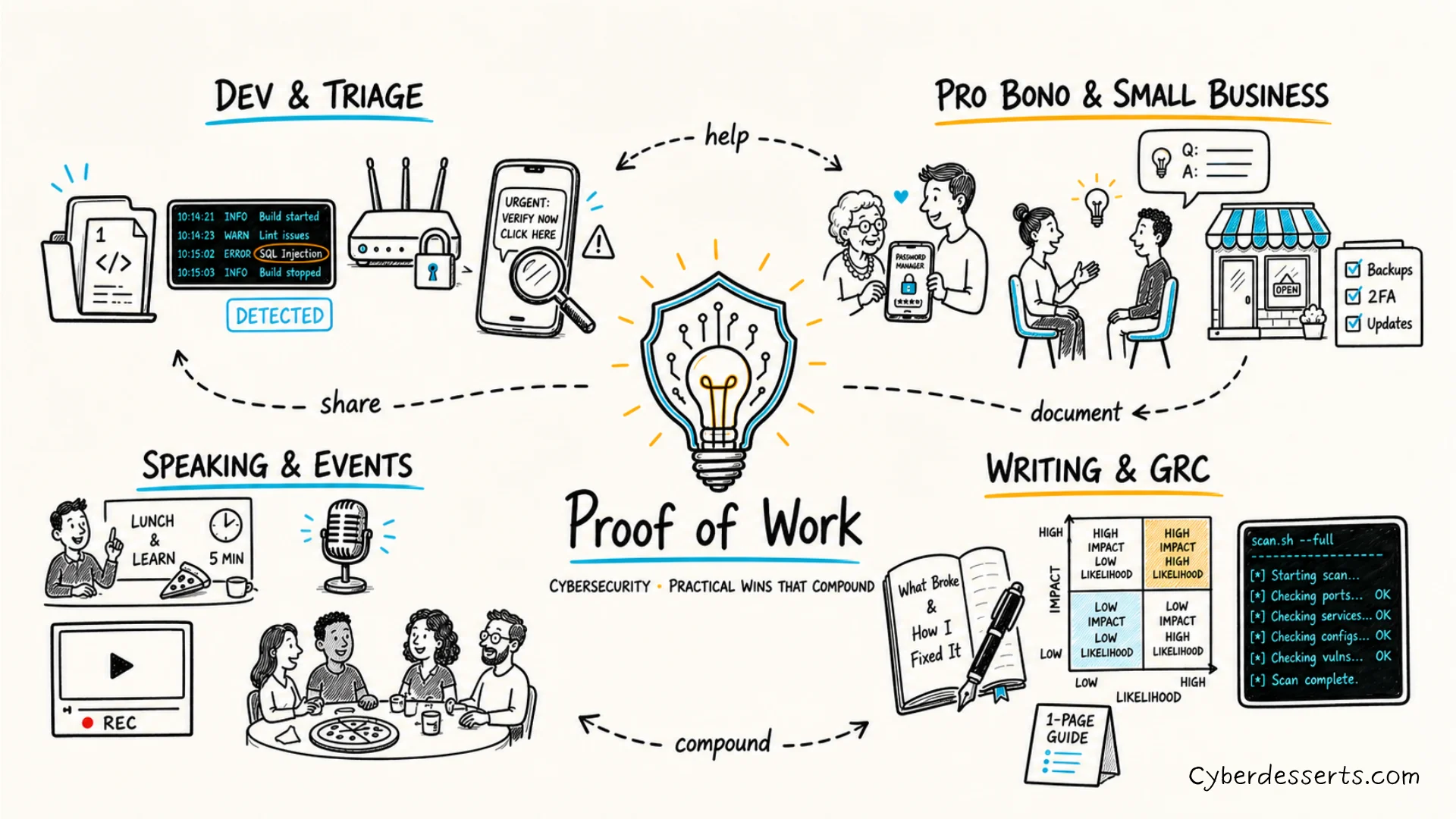
Hiring managers rarely reject you for lacking a mega project. They reject you because nothing in your application proves you can do the work. This map shows the small, zero budget security wins that compound into evidence an employer can see, starting with something you could finish today.
What the Map Shows
- Four clusters of security work you can start with no budget, no permission and no waiting for perfect.
- A compounding loop at the centre: help someone, document it, share it, repeat.
- Every lap leaves an artefact behind, and the artefact is what a hiring manager reads.
What Each Kind Proves to an Employer
- Dev & triage: read a build log, spot the SQL injection, lock down a router, call out the phishing text. Shows you can find a real problem and close it without being handed a ticket.
- Pro bono & small business: set a family member up with a password manager, take a local shop through backups, 2FA and updates. Real users and real constraints, which is the part a lab never tests.
- Writing & GRC: a "what broke and how I fixed it" post, a risk matrix, a one-page guide distilled from a policy nobody reads. Translation is most of the job, and the write-up is your interview answer already prepared.
- Speaking & events: a five-minute lunch and learn, a recorded walkthrough, a good question asked at a meetup. Explaining your work in front of people is how you get referred before a role is advertised.
Where Hiring Managers Will Find It
Evidence nobody can find is not evidence. You get a couple of minutes of a hiring manager's attention, so pick one home, keep it current and link it from the top of your CV rather than scattering work across five half-finished profiles.
- A simple site of your own: one page per win. What the problem was, what you did, what changed. A free static host is enough, and you control the domain and the narrative.
- GitHub: scripts, detection rules, lab configs, even the one-page guides as Markdown. A README that explains why you built it beats a repo of unexplained code.
- LinkedIn write-ups: the cheapest unit of proof. Each post is a searchable artefact a recruiter can read in ninety seconds, and recruiters do search.
Write down permission and scope for anything done on someone else's kit. It belongs in your portfolio only with their agreement, with names, addresses and screenshots redacted. Being trusted with that access is part of what you are demonstrating.
Turn This Into Offers
The map shows the habit. The career guide shows the path: role by role skills, the portfolio projects that prove them, and the certification strategy for each track.
Get the Free 2026 Cybersecurity Career GuideBrowse every careers article in the Library →
Explore all free tools and downloads in Tools & Resources →